
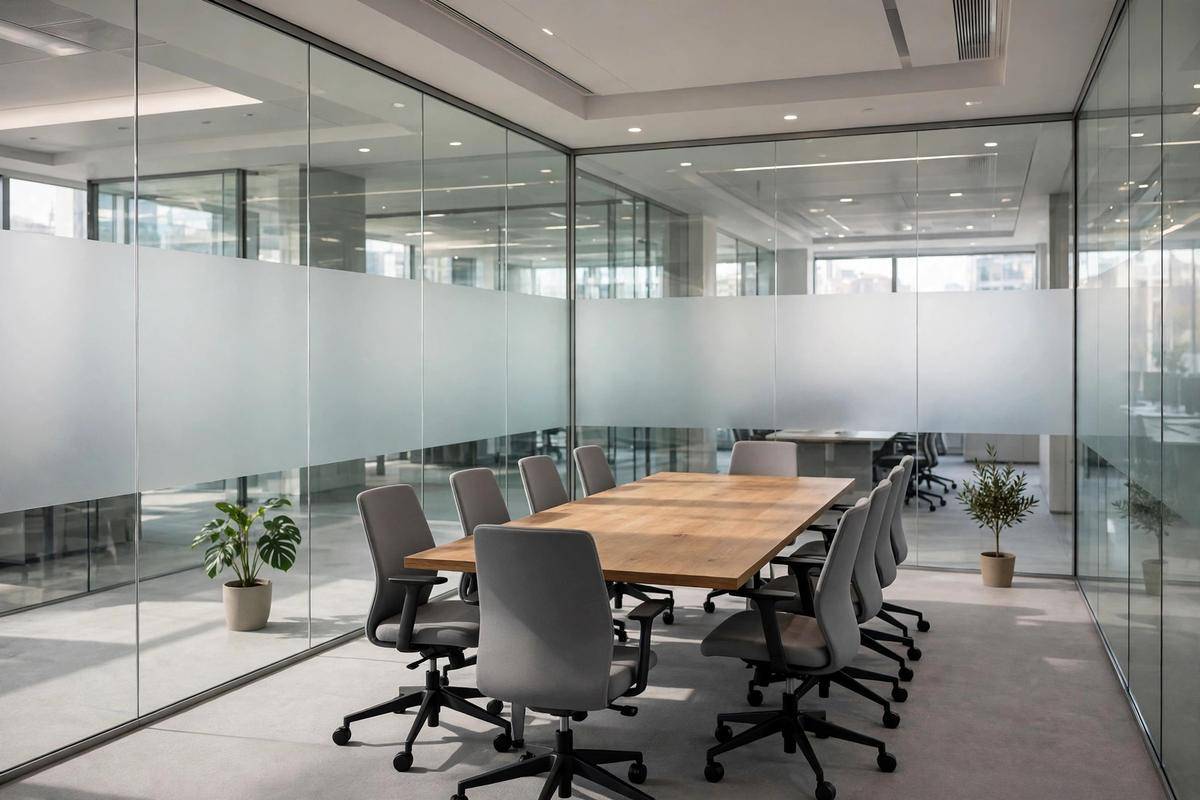
For most Jeffersonville offices, frosted window film is the straightforward choice for privacy, because it obscures the view while keeping natural light. Decorative window film suits glass where privacy and appearance both matter, such as an entry or a customer-facing partition. The choice comes down to one question: does the glass need to hide what is behind it, or to hide it and carry a design as well?
The short answer: frosted vs. decorative film in Jeffersonville
Frosted film scatters light so shapes and shadows show but readable detail does not at normal viewing distances. Decorative film adds pattern, stripes, or lettering, with privacy that varies by design. If the goal is to keep paperwork, screens, or meetings out of view, frosted film is the direct answer. If the glass faces customers and should carry the look of the business, decorative film earns its place. Many offices use both, on different glass.
If your goal is simply to stop people from seeing screens or private meetings, frosted film does the job. If you want the glass to look considered as well as private, decorative film adds that layer. Cost is a factor, but it is not the deciding one: the deciding factor is what each piece of glass has to do.
What is frosted window film and what does it do?
Frosted window film is a translucent sheet applied to glass that scatters light, so shapes and shadows show but readable text and faces do not at normal viewing distances. It gives the effect of etched glass without replacing the glass, and it keeps natural light in the room. It suits interior partitions, conference rooms, entry glass, and street-level office windows.
Two common forms are standard frost, a uniform matte finish, and gradient frost, which fades from opaque at the bottom to clear at the top. Standard frost gives privacy at eye level throughout. Gradient frost gives privacy where people sit and stand, while keeping a clear band above. Which suits a room depends on the glass, the ceiling height, and how the room is used.
Frosted film also cuts glare on monitors. In a west-facing office, afternoon sun can make screens hard to read for part of the day, and frost softens that brightness without darkening the room. For offices along Veterans Parkway and East 10th Street, where large office and retail glass faces the corridors, glare and street-level privacy often arrive together. See the commercial window tinting page.
What is decorative window film and where does it fit?
Decorative window film is a printed or patterned film that adds a visual element to glass while providing varying levels of privacy. Options include frosted stripes, geometric patterns, faux etched effects, and colored films. The privacy it gives depends on the pattern: dense patterns obscure more, open patterns obscure less.
In Jeffersonville, small professional offices, medical suites, and storefronts along the commercial corridors often want a polished look without replacing glass. Decorative film gives a custom appearance on existing glass, and ask whether it can carry a logo, a stripe, or a pattern that matches the business. For storefront glass, lettering also raises a sign question; the law guide covers the window-sign rules without figures here.
One caveat: decorative film with patterns or gradients provides partial privacy. If someone stands close to the glass, they may still see through the clear portions. For full privacy, a decorative border is sometimes combined with a frosted center, so the glass looks designed and still obscures the view. Ask the shop how a pattern reads at different distances before choosing.
Frosted or decorative window film for a Jeffersonville office?
There is no universal winner. Frosted film suits pure privacy, decorative film suits branding and appearance, and many offices use both. To decide, ask three questions:
- How sensitive is the space? If the room holds private meetings, records, or patient areas, full frost is the direct answer. Decorative patterns can leave gaps.
- Who sees the glass? Customer-facing glass, such as a lobby or a storefront, benefits from decorative film that carries the look of the business. Employee-only areas can use standard frost.
- What does the glass have to do besides privacy? Glare control, light levels, and the look of the room all matter. A film that suits a conference room may not suit an entry.
For most offices, a hybrid works: frosted film on interior partitions and conference rooms, decorative film on the front entry and any glass that faces customers. That gives privacy where it is needed and appearance where it is seen. Describe each piece of glass when you call, and ask what suits each one.
What decides the cost of office privacy window film in Jeffersonville
No prices are published on this site, and no figure is stated here. A quote for office privacy film depends on the film type, the amount of glass, whether the film is standard or custom-printed, the condition and access of the glass, and whether old film has to come off first. Ask whether custom decorative work is offered, and what design and printing it involves.
What is included in a quote matters as much as the figure: film, fitting, surface prep, and removal of old film where it exists. Ask what is included before comparing quotes, and describe the glass, the number of panes, and whether the film is standard or custom when you call.
Compared with replacing glass with frosted panels, film is usually the lower-cost route, and it can be changed if needs change. No figure is stated here for either route. The honest comparison is the one made for your glass, with both options described.
Can window film provide privacy for a Jeffersonville office?
Yes. Frosted and decorative films obscure the view by scattering light or by pattern, and they do so regardless of the time of day, because they physically obscure the glass. Reflective films behave differently: they rely on a light difference between inside and outside, so their privacy changes with lighting conditions. For steady privacy, frost or decorative film is the direct answer.
Privacy film is also discussed for ground-level offices and medical suites, where street-level glass faces foot traffic. It limits the view from outside while keeping natural light inside. Any compliance requirement for a medical or professional space is a question for the business and its advisers, not a claim made here. See the privacy window film page.
One thing to know: privacy film does not soundproof a room. If noise is the problem, film is not the answer. If holding glass together matters as well as privacy, ask about security window film and what it can and cannot do.
Common mistakes with office privacy film
The same issues come up repeatedly with office privacy film. Here is what to avoid:
- Filming dirty glass. Debris under film shows as bubbles and marks. Glass prep matters, and it is worth asking how prep is handled.
- Using the wrong film for the glass type. Some films trap heat in ways that can stress double-pane units. Ask whether the film offered suits the glass it will go on, including coated and double-pane units.
- Do-it-yourself fitting on large windows. Film is unforgiving on large panes: one wrinkle or crease and the piece starts over. Large glass is a professional fitting conversation.
- Ignoring the ratings that apply to commercial spaces. Ask what ratings or requirements apply to film in your space, and whether the film offered meets them. Do not assume.
Another mistake: choosing a film that is too dark. Dark film can make an office feel closed in and push up lighting needs. Frosted film gives privacy without sacrificing daylight, which is often the point of the exercise.
When to call a professional
If more than a couple of small windows are involved, or if the glass is part of a storefront or an exterior wall, call a professional. Fitting, glass compatibility, and the questions that apply to commercial spaces all belong in the same conversation. For downtown storefronts, the historic review question is unresolved and should be asked before work starts; see the Downtown Jeffersonville page.
The commercial window tinting page combines privacy with heat and glare control. Describe the office, the glass, and what each room needs when you call.
Get help with window tinting in Jeffersonville
Whether the need is frosted film for a private conference room or decorative film for a lobby, start by describing the glass, the rooms, and what each piece of glass has to do. The shop can talk through frosted and decorative options on that basis.
Call Doyles Window Tinting at (812) 382-2757 during open hours to talk through your office.